Echos from the Black Box
Counterfactual Explanations and Probabilistic Methods for Trustworthy Machine Learning
November 4, 2026
Quick Introduction
- Currently 2nd year of PhD in Trustworthy Artificial Intelligence at Delft University of Technology.
- Previously, educational background in Economics and Finance and two years in Monetary Policy at the Bank of England.
- Interested in applying Trustworthy AI to real-world problems, particularly in the financial sector.


Example: Consumer Credit
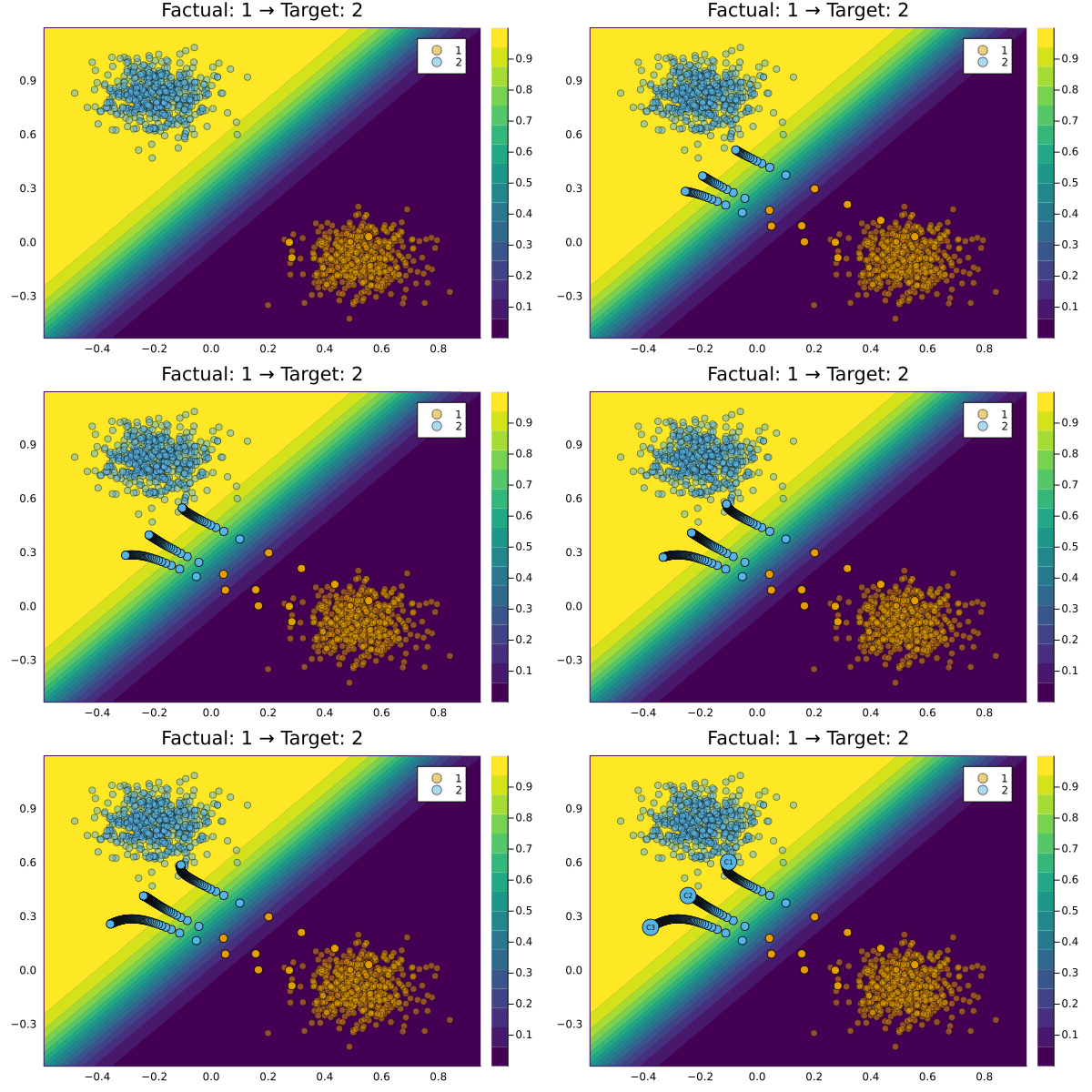
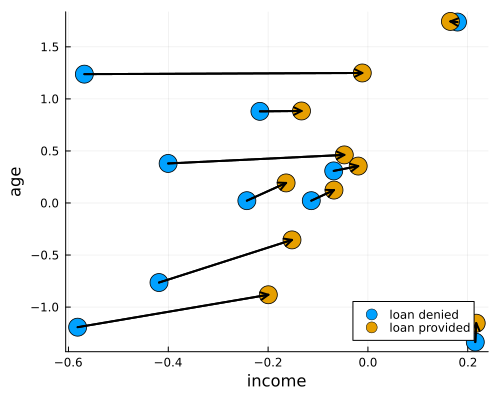
From ‘loan denied’ to ‘loan supplied’: CounterfactualExplanations.jl 📦.
Conformal Prediction
Conformal Prediction is a model-agnostic, distribution-free approach to Predictive Uncertainty Quantification: ConformalPrediction.jl 📦.


Joint Energy Models
Joint Energy Models (JEMs) are hybrid models trained to learn the conditional output and input distribution (Grathwohl et al. 2020): JointEnergyModels.jl 📦.

Recourse Dynamics
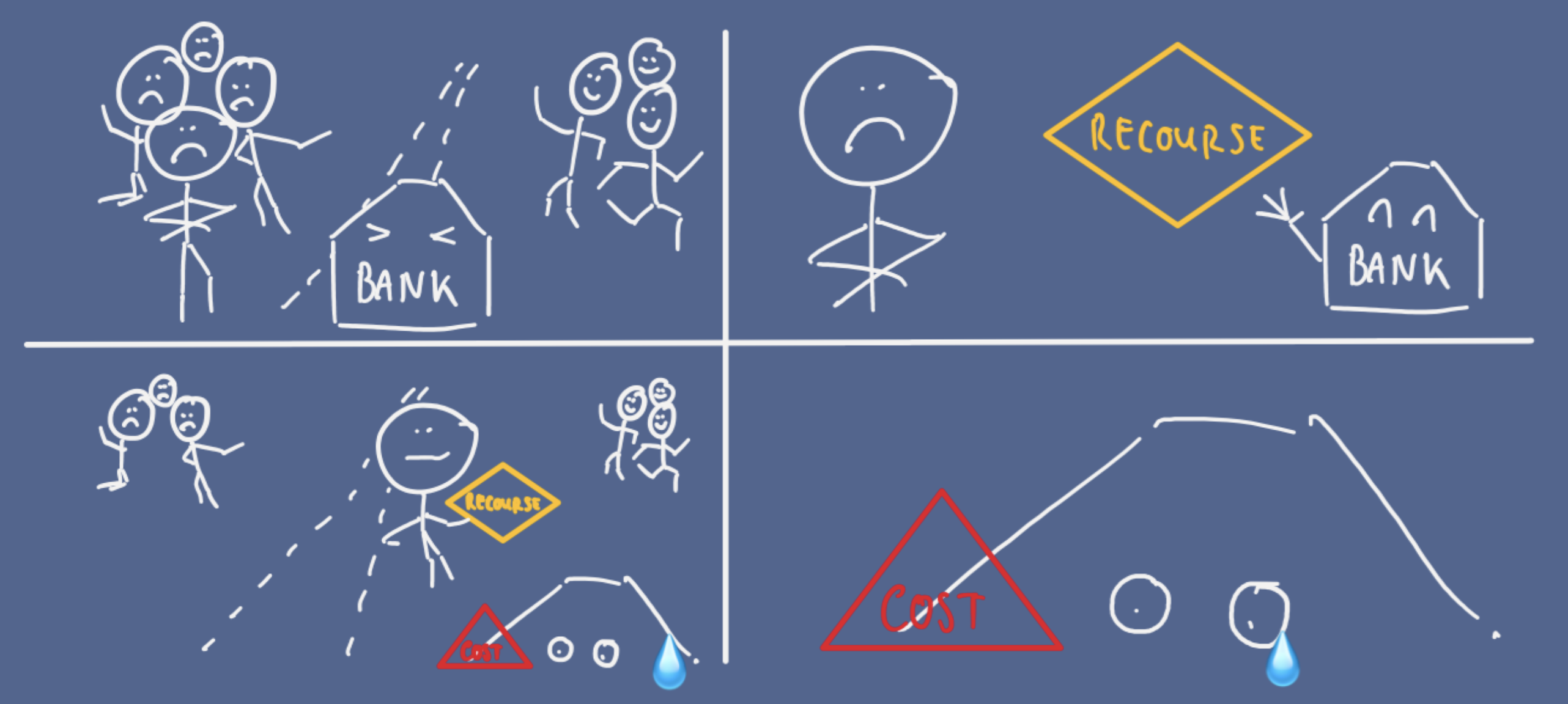
We present evidence suggesting that state-of-the-art applications of Algorithmic Recourse to groups of individuals induce large domain and model shifts and propose ways to mitigate this (IEEE SaTML paper).
Joint work with Giovan Angela, Karol Dobiczek, Aleksander Buszydlik, Arie van Deursen and Cynthia C. S. Liem (all TU Delft).
Pick your Poison?
All of these counterfactuals are valid explanations for the model’s prediction. Which one would you pick?

What do Models Learn?
These images are sampled from the posterior distribution learned by the model. Looks different, no?

ECCCos from the Black Box
We propose a framework for generating Energy-Constrained Conformal Counterfactuals (ECCCos) which explain black-box models faithfully.
Joint work with Mojtaba Framanbar (ING), Arie van Deursen (TU Delft) and Cynthia C. S. Liem (TU Delft).


🐶 Taija
Research informs development, development informs research.

Trustworthy Artificial Intelligence in Julia.
Taija is a collection of open-source packages for Trustworthy AI in Julia. Our goal is to help researchers and practitioners assess the trustworthiness of predictive models.
Our work has been presented at JuliaCon 2022 and will be presented again at JuliaCon 2023 and hopefully beyond.
Questions?