Explaining Models or Modelling Explanations
Counterfactual Explanations and Algorithmic Recourse for Trustworthy AI
April 16, 2026
Background
Economist, then PhD CS
How can we make opaque AI more trustworthy?
Explainable AI, Adversarial ML, Probabilistic ML
Core developer and maintainer of Taija (Trustworthy AI in Julia)

Training Opaque Models
Tweaking Parameters
Objective:
\[ \begin{aligned} \min_{\textcolor{orange}{\theta}} \{ {\text{yloss}(M_{\theta}(\mathbf{x}),\mathbf{y})} \} \end{aligned} \]
Solution:
\[ \begin{aligned} \theta_{t+1} &= \theta_t - \nabla_{\textcolor{orange}{\theta}} \{ {\text{yloss}(M_{\theta}(\mathbf{x}),\mathbf{y})} \} \\ \textcolor{orange}{\theta^*}&=\theta_T \end{aligned} \]

Explaining Opaque Models
Tweaking Inputs
Objective:
\[ \begin{aligned} \min_{\textcolor{purple}{\mathbf{x}}} \{ {\text{yloss}(M_{\textcolor{orange}{\theta^*}}(\mathbf{x}),\mathbf{y^{\textcolor{purple}{+}} }) + \lambda \text{reg}(\mathbf{x};\cdot) } \} \end{aligned} \]

Explaining Opaque Models
Tweaking Inputs
Objective:
\[ \begin{aligned} \min_{\textcolor{purple}{\mathbf{x}}} \{ {\text{yloss}(M_{\textcolor{orange}{\theta^*}}(\mathbf{x}),\mathbf{y^{\textcolor{purple}{+}} }) + \lambda \text{reg}(\mathbf{x};\cdot)} \} \end{aligned} \]
Solution:
\[ \begin{aligned} \mathbf{x}_{t+1} &= \mathbf{x}_t - \nabla_{\textcolor{purple}{\mathbf{x}}} \{ \text{yloss}(M_{\textcolor{orange}{\theta^*}}(\mathbf{x}),\mathbf{y^{\textcolor{purple}{+}} }) \\&+ \lambda \text{reg}(\mathbf{x};\cdot) \} \\ \textcolor{purple}{\mathbf{x}^*}&=\mathbf{x}_T \end{aligned} \]

Algorithmic Recourse
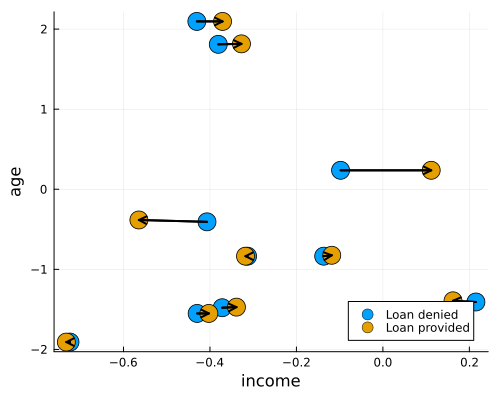
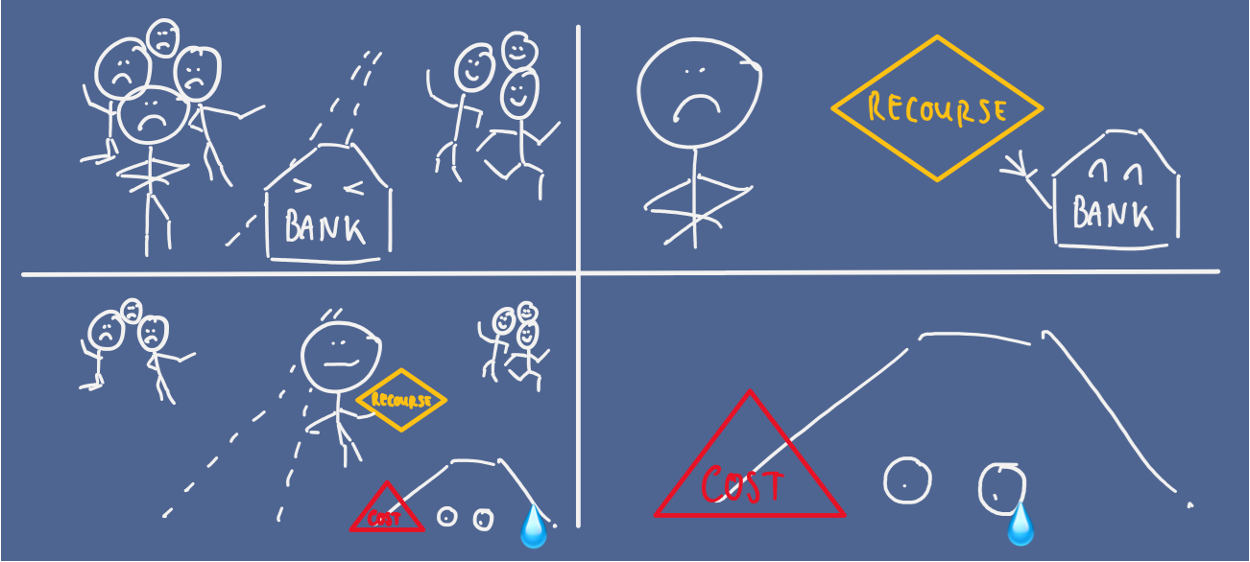
Provided CE is valid, plausible and actionable, it can be used to provide recourse to individuals negatively affected by models.
“If your income had been
x, then …”
Mitigation Strategies
Reframed Objective
\[ \begin{aligned} \mathbf{s}^\prime &= \arg \min_{\mathbf{s}^\prime \in \mathcal{S}} \{ {\text{yloss}(M(f(\mathbf{s}^\prime)),y^*)} \\ &+ \lambda_1 {\text{cost}(f(\mathbf{s}^\prime))} + \lambda_2 {\text{extcost}(f(\mathbf{s}^\prime))} \} \end{aligned} \]
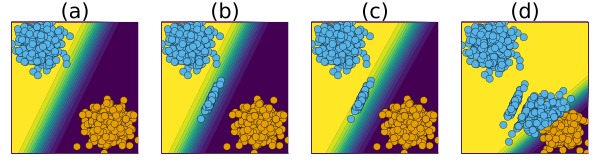
- Even simple mitigation strategies can help.
- Reducing hidden cost is (roughly) equivalent to ensuring plausibility.
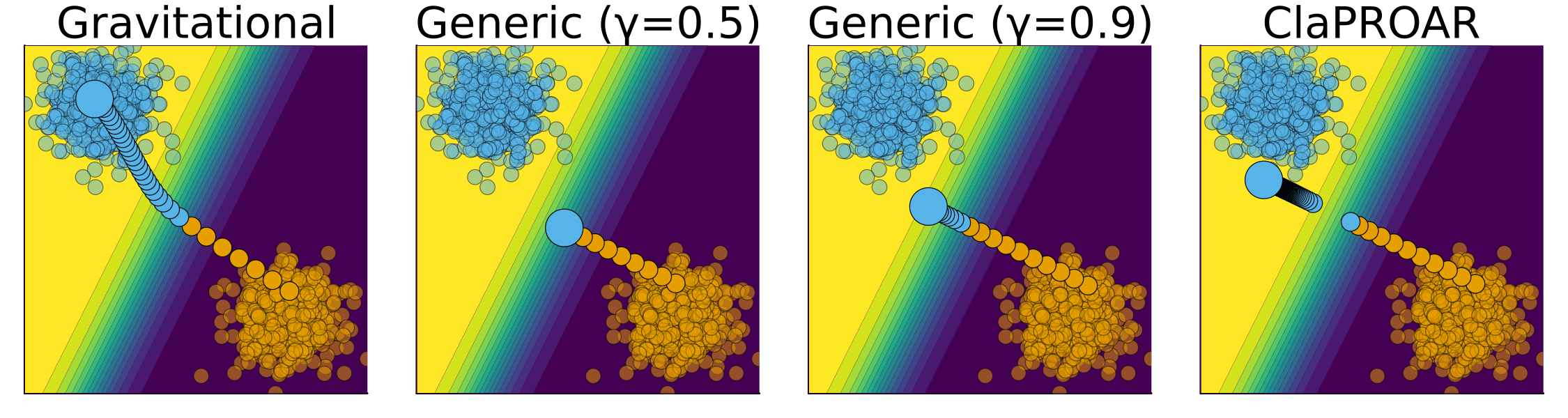
Plausibility at all cost?
All of these counterfactuals are valid explanations for the model’s prediction.
Pick your poison …
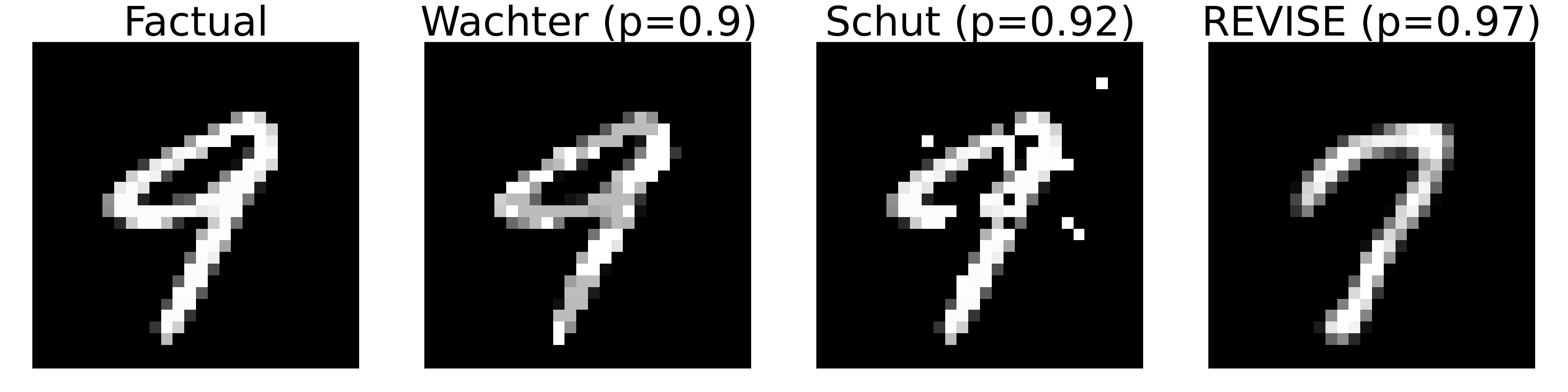
Faithful First, Plausible Second
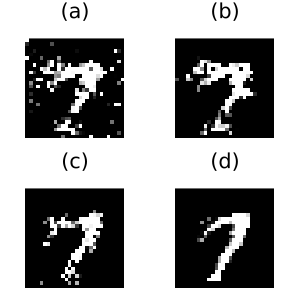

Counterfactual Training
- Contrast faithful CE with data \(\rightarrow\) Explainability \(\uparrow\)
- Feature mutability constraints \(\rightarrow\) Actionability \(\uparrow\)(holds provably under certain assumptions)
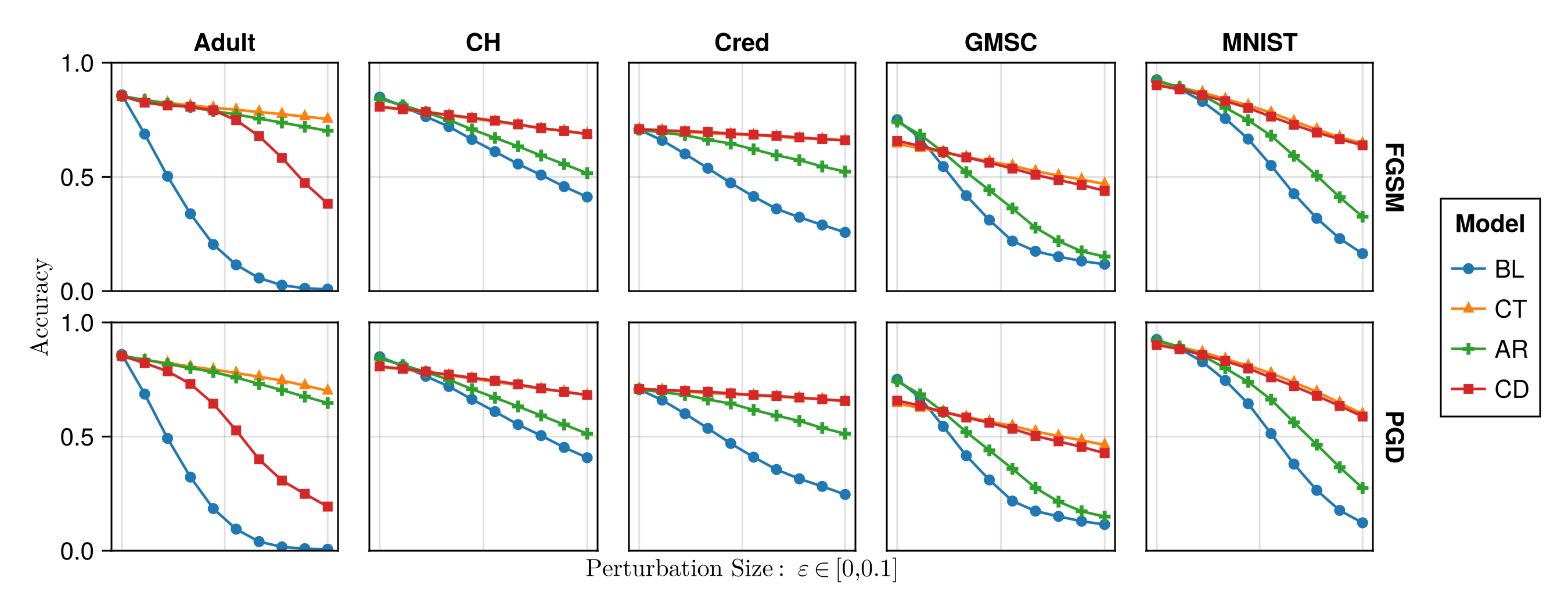
- Bonus: use nascent CE as AE \(\rightarrow\) Robustness \(\uparrow\)
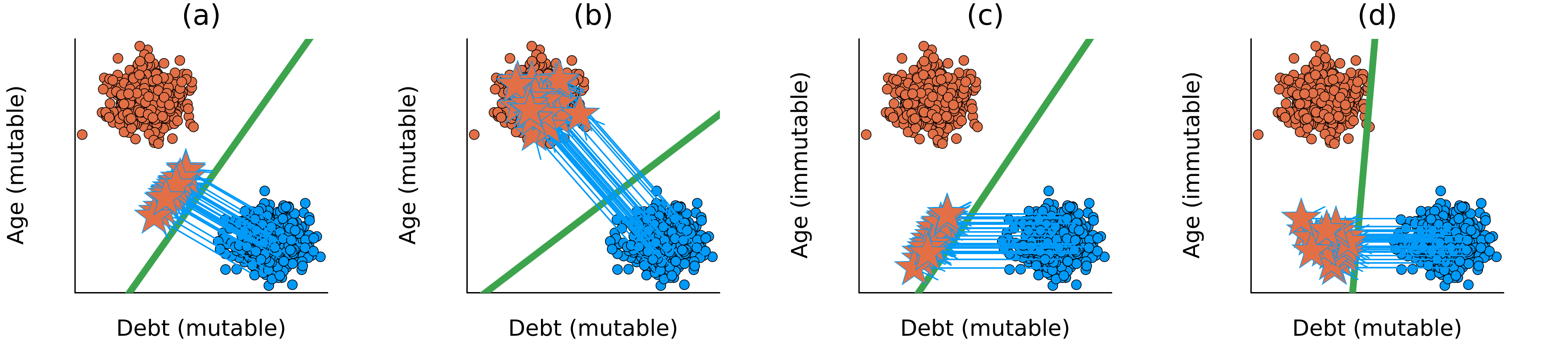
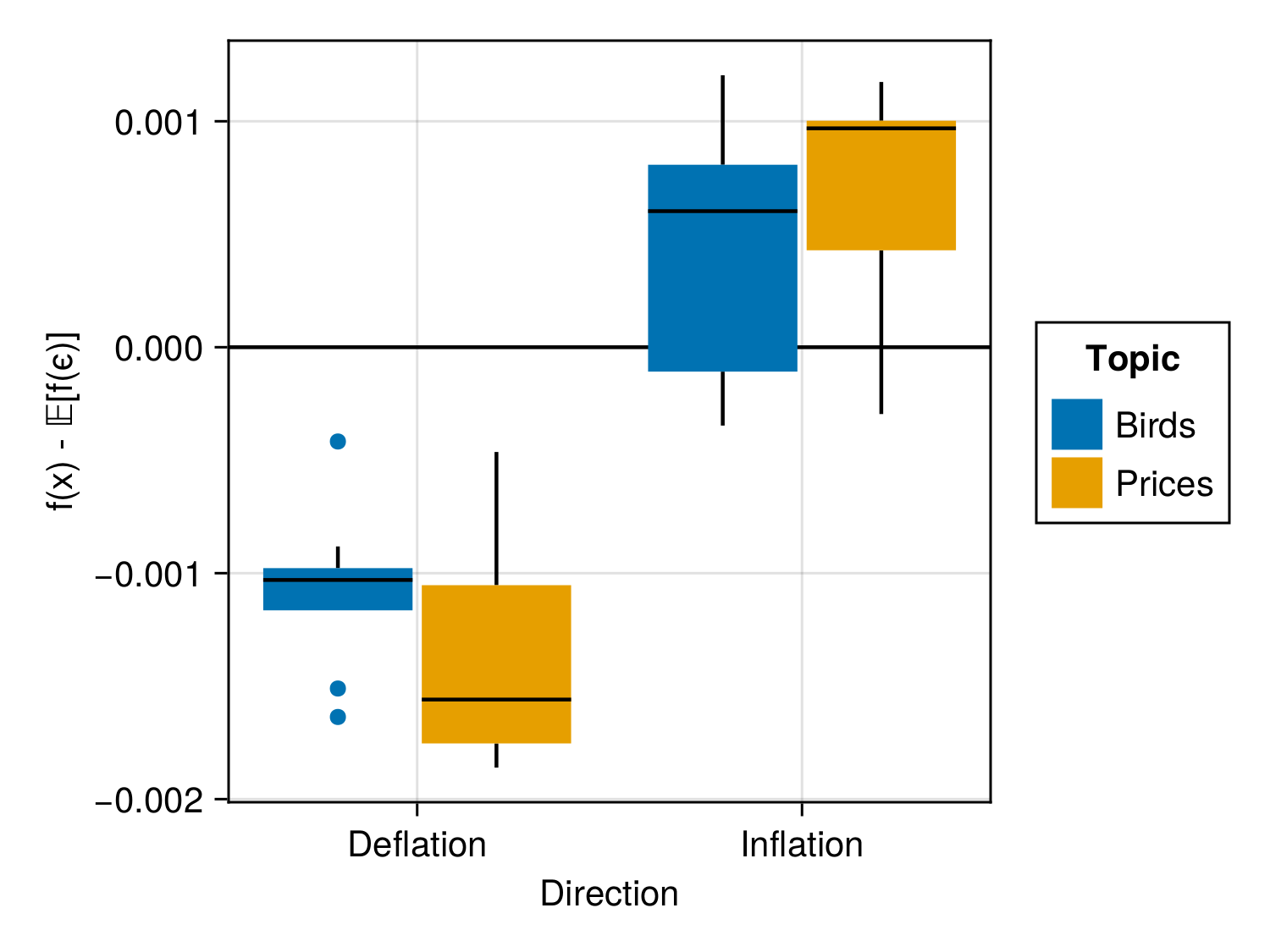
Counterfactual Training: Results


Check it out!



Taija
- Model Explainability (CounterfactualExplanations.jl)
- Predictive Uncertainty Quantification (ConformalPrediction.jl)
- Effortless Bayesian Deep Learning (LaplaceRedux.jl)
- … and more!
- Work presented @ JuliaCon 2022, 2023, 2024.
- Google Summer of Code and Julia Season of Contributions 2024.
- Total of three software projects @ TU Delft.

Trustworthy AI in Julia: github.com/JuliaTrustworthyAI
Spurious Sparks of AGI
We challenge the idea that the finding of meaningful patterns in latent spaces of large models is indicative of AGI1.