Counterfactual Training
Teaching Models Plausible and Actionable Explanations
March 23, 2026
Training Opaque Models
Tweaking Parameters
Objective:
\[ \begin{aligned} \min_{\textcolor{orange}{\theta}} \{ {\text{yloss}(M_{\theta}(\mathbf{x}),\mathbf{y})} \} \end{aligned} \]
Solution:
\[ \begin{aligned} \theta_{t+1} &= \theta_t - \nabla_{\textcolor{orange}{\theta}} \{ {\text{yloss}(M_{\theta}(\mathbf{x}),\mathbf{y})} \} \\ \textcolor{orange}{\theta^*}&=\theta_T \end{aligned} \]
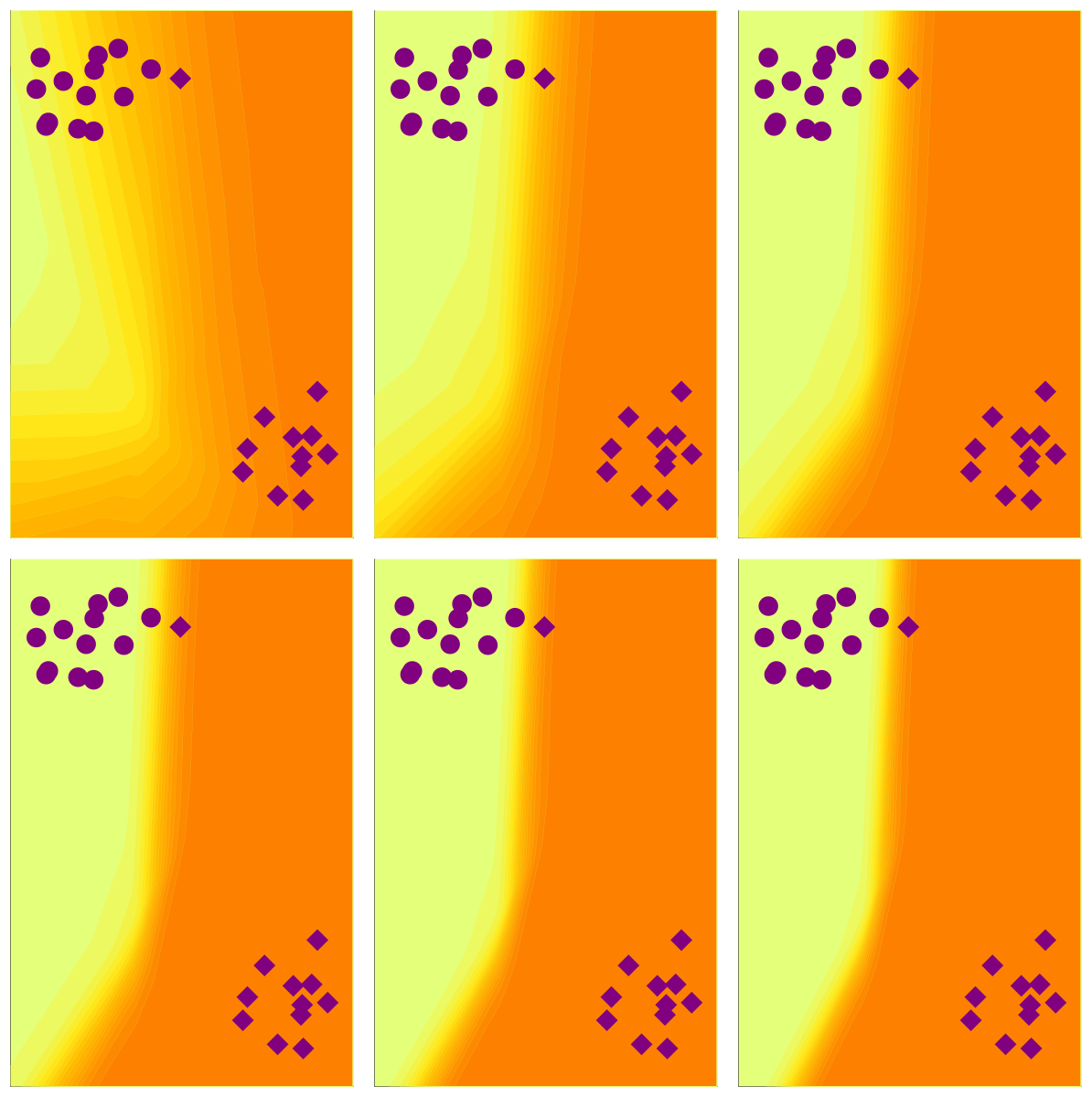
Explaining Opaque Models
Tweaking Inputs
Objective:
\[ \begin{aligned} \min_{\textcolor{purple}{\mathbf{x}}} \{ {\text{yloss}(M_{\textcolor{orange}{\theta^*}}(\mathbf{x}),\mathbf{y^{\textcolor{purple}{+}} }) + \lambda \text{reg}(\mathbf{x};\cdot) } \} \end{aligned} \]
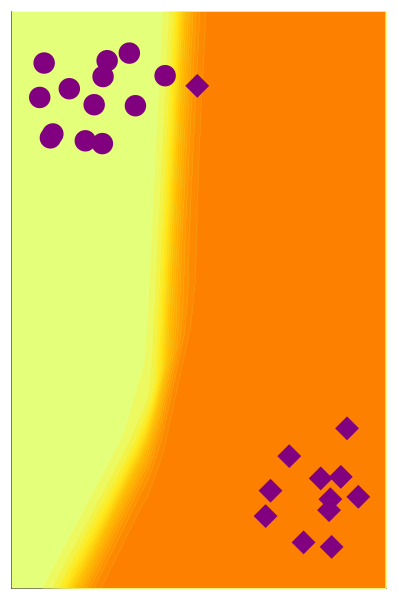
Explaining Opaque Models
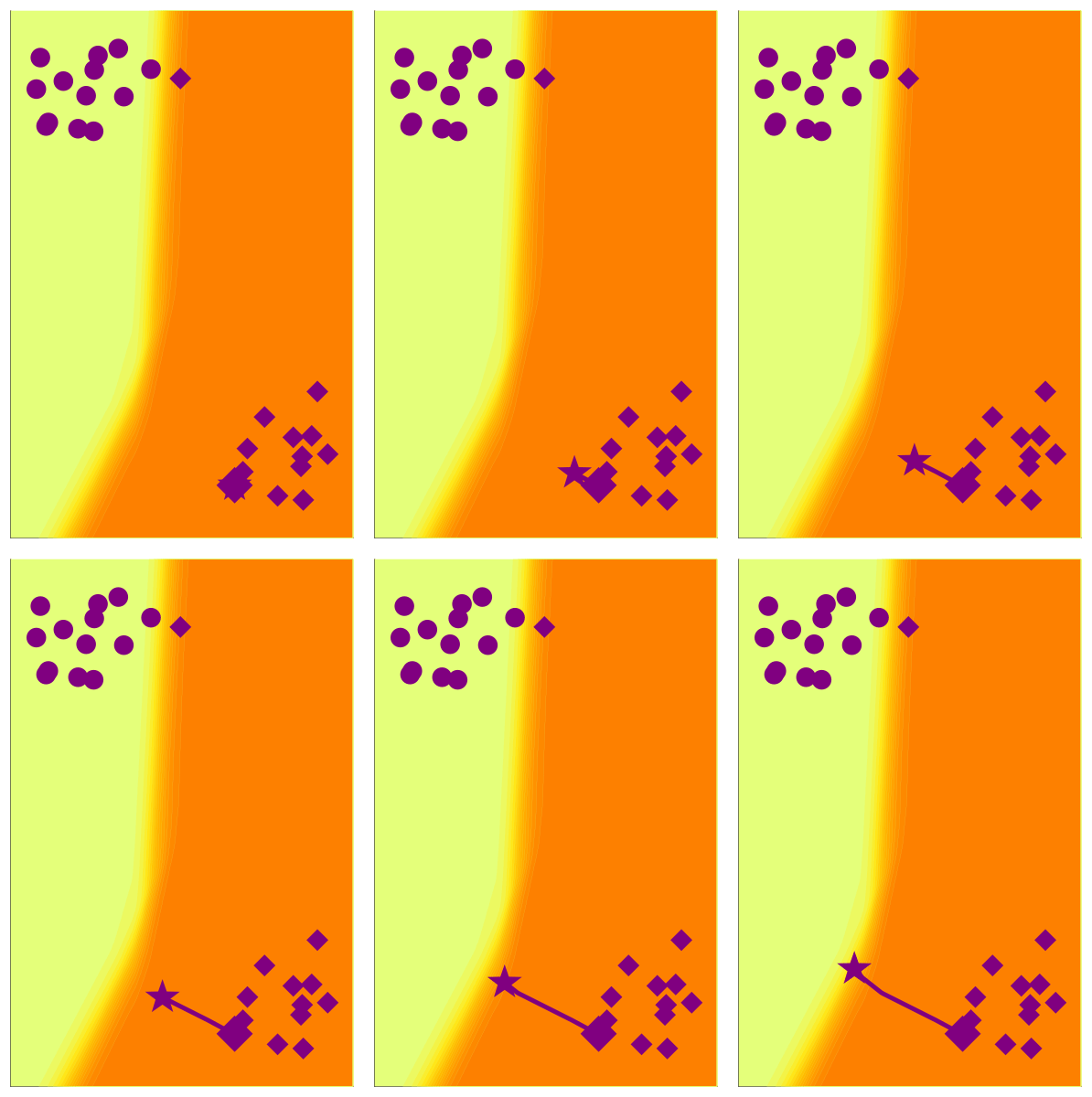
Tweaking Inputs
Objective:
\[ \begin{aligned} \min_{\textcolor{purple}{\mathbf{x}}} \{ {\text{yloss}(M_{\textcolor{orange}{\theta^*}}(\mathbf{x}),\mathbf{y^{\textcolor{purple}{+}} }) + \lambda \text{reg}(\mathbf{x};\cdot)} \} \end{aligned} \]
Solution:
\[ \begin{aligned} \mathbf{x}_{t+1} &= \mathbf{x}_t - \nabla_{\textcolor{purple}{\mathbf{x}}} \{ \text{yloss}(M_{\textcolor{orange}{\theta^*}}(\mathbf{x}),\mathbf{y^{\textcolor{purple}{+}} }) \\&+ \lambda \text{reg}(\mathbf{x};\cdot) \} \\ \textcolor{purple}{\mathbf{x}^*}&=\mathbf{x}_T \end{aligned} \]
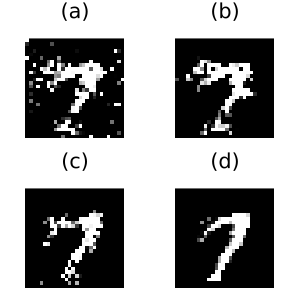
Plausibility at all cost?
All of these counterfactuals are valid explanations for the model’s prediction.
Pick your poison …
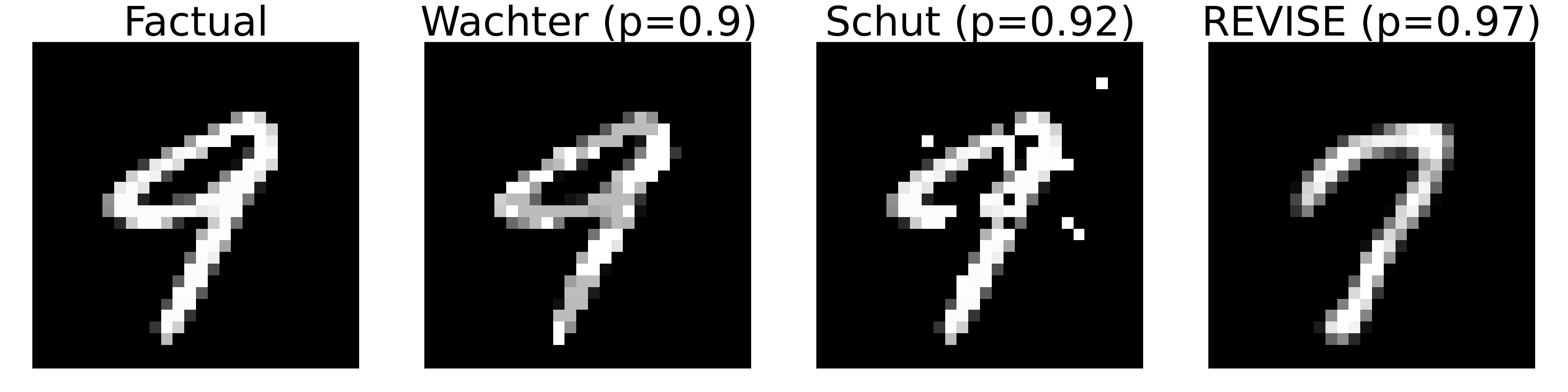
Faithful First, Plausible Second

Counterfactual Training
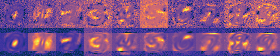
- Contrast faithful CE with data \(\rightarrow\) Explainability \(\uparrow\)
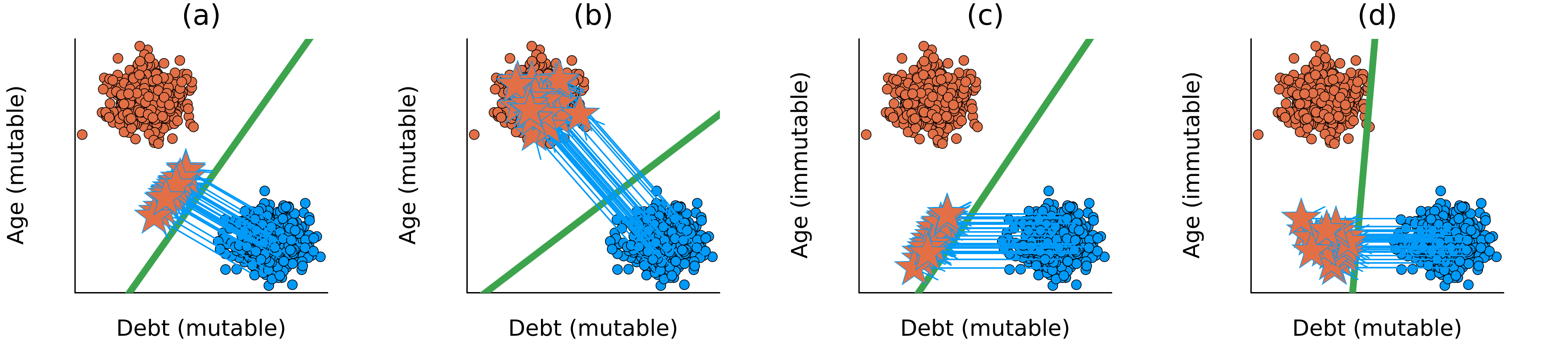
- Feature mutability constraints \(\rightarrow\) Actionability \(\uparrow\)(holds provably under certain assumptions)
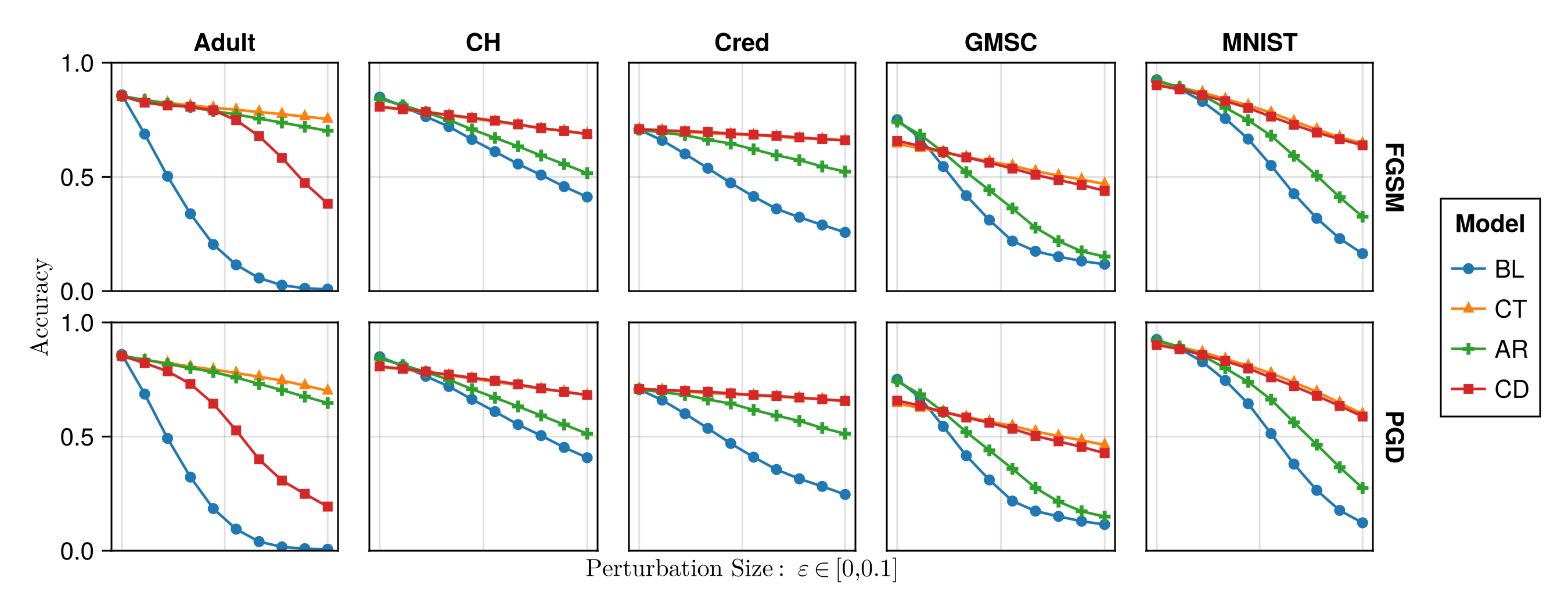
- Bonus: use nascent CE as AE \(\rightarrow\) Robustness \(\uparrow\)
Counterfactual Training: Results

Check it out!